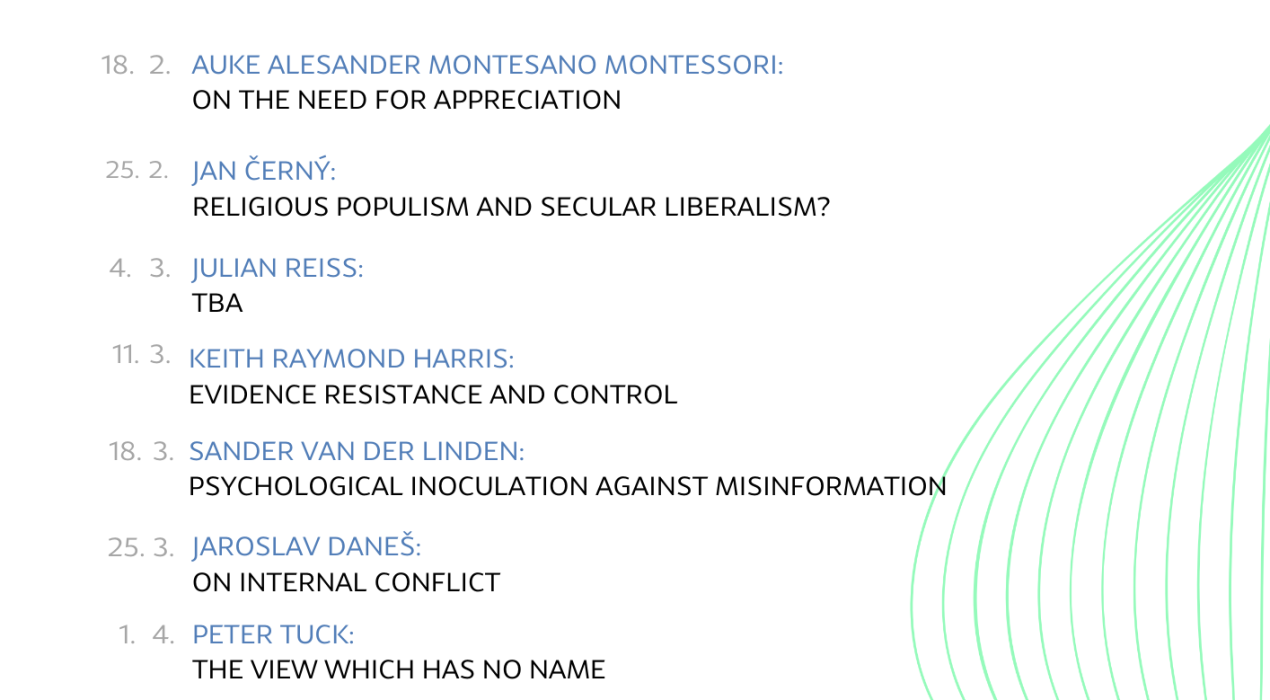
Program LMS Centra: letní semestr 2026
Zveme všechny zájemce na nový cyklus přednášek LMS Centra pro letní semestr 2026. Semináře pravidelně probíhají v místnosti SM4 od 14:05. Finančně podpořeno z projektu Vědění ve věku nedůvěry, CZ.02.01.01/00/23_025/0008711.
Read More ›

Michal Hubálek: Co je to historická událost? Tři argumenty proti jednoznačnosti minulosti.
Michal Hubálek (Univerzita Hradec Králové) Co je to historická událost? Tři argumenty proti jednoznačnosti minulosti. Sledovat můžete také na: https://cesnet.zoom.us/j/91813080382 ABSTRAKT: Široce chápaný anti-realismus je dnes bezpochyby dominantní výchozí pozicí pro současnou teorii a filosofii historie. Na nejzákladnější úrovni je spor mezi historickým realismem a anti-realismem sporem o povahu a poznatelnost historických událostí. Jinými slovy: historičtí realisté a anti-realisté mají rozdílnou odpověď na otázku „co je to historická událost?“ Můj příspěvek se pokusí objasnit vybrané roviny tohoto sporu prostřednictvím představení jedné vývojové linie tří amerických filosofů (historie); konkrétně jde o Arthura C. Danta, Louise O. Minka a Paula A. Rotha, jejichž práce pokrývají kritické období od 60. let minulého století, kdy dochází k postupné demolici positivistických základů vědy, až po metodologicky pluralistickou současnost. Struktura příspěvku bude potom následující: po úvodní kontextuální části se zaměřím na Danta, na jeho „narativní věty“ a jeho argument pro epistemickou otevřenost minulosti; poté rozeberu Minkovo radikální odmítnutí možnosti jednoho všezahrnujícího historického narativu, tedy jeho odmítnutí představy „Universální Historie;“ a nakonec se budu věnovat Rothovi a jeho artikulaci konceptu „narativního vysvětlení“ jakožto legitimní formy (vědeckého) vysvětlení na pozadí jeho argumentu pro ontologickou mnohost minulostí. V samotném závěru mého příspěvku se ještě pokusím linii […]
Read More ›
Lucie Stuchlíková: Politika a média
Lucie Stuchlíková (Seznam Zprávy, Vlevo dole) Politika a média ABSTRAKT: Jak se změnil vztah politiků a novinářů v době moderní komunikace. Potřebují politici ještě k něčemu média, nebo si vystačí s vlastními sděleními na sociálních sítích. Jak se novinářům v takovém nastavení daří naplňovat svoji kontrolní roli. A co nám o tomhle všem řekly právě skončené parlamentní volby? Otázky, na které se pokusíme najít odpověď společně s Lucií Stuchlíkovou, polovinou autorského dua z politického podcastu Vlevo dole.
Read More ›

Robert McKenna: Science Communication as Propaganda
Robert McKenna (University of Liverpool) Science Communication as Propaganda Sledovat můžete také na: https://cesnet.zoom.us/j/91813080382 ABSTRAKT: There is a tension at the heart of science communication. On the one hand, its advocates often say that it simply aims to inform the public about relevant advances in science, along with providing them with scientific information that is relevant to their lives and choices (getting vaccinated, buying an electric vehicle, etc.). On the other hand, some public science communication seems more geared towards persuading the public of things (the need to get vaccinated or to buy an electric vehicle) than simply informing them. Moreover, science communication also occurs in the context of public policy making, where the role of the science communicator is not simply to inform policy makers of relevant scientific knowledge but to offer guidance and recommendations. Science communication is therefore intertwined with the technocratic structure of many modern societies. In this talk I suggest that viewing certain forms of science communication as a distinctive kind of propaganda is a helpful way of understanding the tension at the heart of science communication. One reason why it is helpful is it provides a plausible explanation of the prevalence of […]
Read More ›

Jiří Holba: Apóha. Nominalismus a poznání v buddhistické filosofii
Jiří Holba (Akademie věd České republiky) Apóha. Nominalismus a poznání v buddhistické filosofii ABSTRAKT: Tématem přednášky je buddhistická sémantická teorie apóha (dosl. „vyloučení [apóha] [jiného]“), která se týká problematiky univerzálií a abstraktních jsoucen. Apóha je metodicky založena na dvojí negaci, kdy například obecný termín „kráva“ odkazuje ke všemu, co není ne-krávou. Pomocí apóhy pak buddhističtí nominalisté charakterizují všechny jednotlivé krávy, aniž by připustili existenci univerzálie „kravskosti“, která naopak podle indických metafyzických realistů skutečně existuje a inherentně obsažena ve všech jednotlivých kravách. Podle buddhistických nominalistů jsou však skutečné pouze jednotliviny (svalakṣaṇa), zatímco abstraktní jsoucna jsou fiktivní, mentální koncepty, vytvořené naší myslí. Na základě těchto dvou diametrálně odlišných pozic se v Indii rozhořel mezi buddhisty a indickými ortodoxními školami jeden z nejostřejších, nejdůležitějších a nejzajímavějších sporů, jenž trval v samotné Indii 600 let.
Read More ›

Carlo Brentari: A collective fixation of meaning. Susanne Langer’s theory of the origin of language on the background of her philosophical anthropology
Carlo Brentari (University of Trento) A collective fixation of meaning. Susanne Langer’s theory of the origin of language on the background of her philosophical anthropology ABSTRAKT: My talk for the LMS Centre will focus on the philosophical-anthropological theory of the origin of language developed by the American philosopher Susanne K. Langer (1895-1985). Langer traces human language – and, in particular, its denotative and communicative functions – back to the expressive vocal utterances of the primates from which humanity has derived. In her inquiry, Langer refers to the work of the language psychologist J. Donovan, who outlines a possible scenario of the birth of language out from pre-linguistic utterances: the spontaneous gatherings that hominids would have dedicated to emotionally relevant events and objects (the death of a conspecific, a killed predator or enemy). Besides being convincing in itself, Langer’s reflection on the origin of language allows us to highlight a question of particular importance in anthropology: how should evolutionism be rethought so that it can account for the emergence of biological phenomena which, like language, were probably not particularly advantageous at their first appearence?
Read More ›

Alberto Acerbi: Digital Age: The Long View
Alberto Acerbi (University of Trento) Digital Age: The Long View ONLINE přednáška! Odkaz na Zoom: https://cesnet.zoom.us/j/91813080382 ABSTRAKT: In my talk, I will discuss how cultural evolution – an umbrella term for evolutionary and cognitive approaches to human culture – can provide a useful framework for understanding how information is produced, transmitted, and selected in contemporary online digital media. A key implication of this perspective is that it suggests, contrary to common concerns, that we are generally wary learners who are not easily influenced. The (limited) spread of online misinformation can be understood in this perspective by focusing on the idea that some cultural traits can be successful because their content taps into general cognitive biases. More generally, given that only a small fraction of online content is misinformation, and, despite the abundance of accurate information, people are often overskeptical or uninterested, I will argue that research should focus more on the spread of reliable news. I will present recent work showing that, like misinformation, factual news exploits evolved cognitive biases, with negative, group-oriented, and dominance-oriented contents consistently predicting engagement. Finančně podpořeno z projektu Vědění ve věku nedůvěry, CZ.02.01.01/00/23_025/0008711.
Read More ›
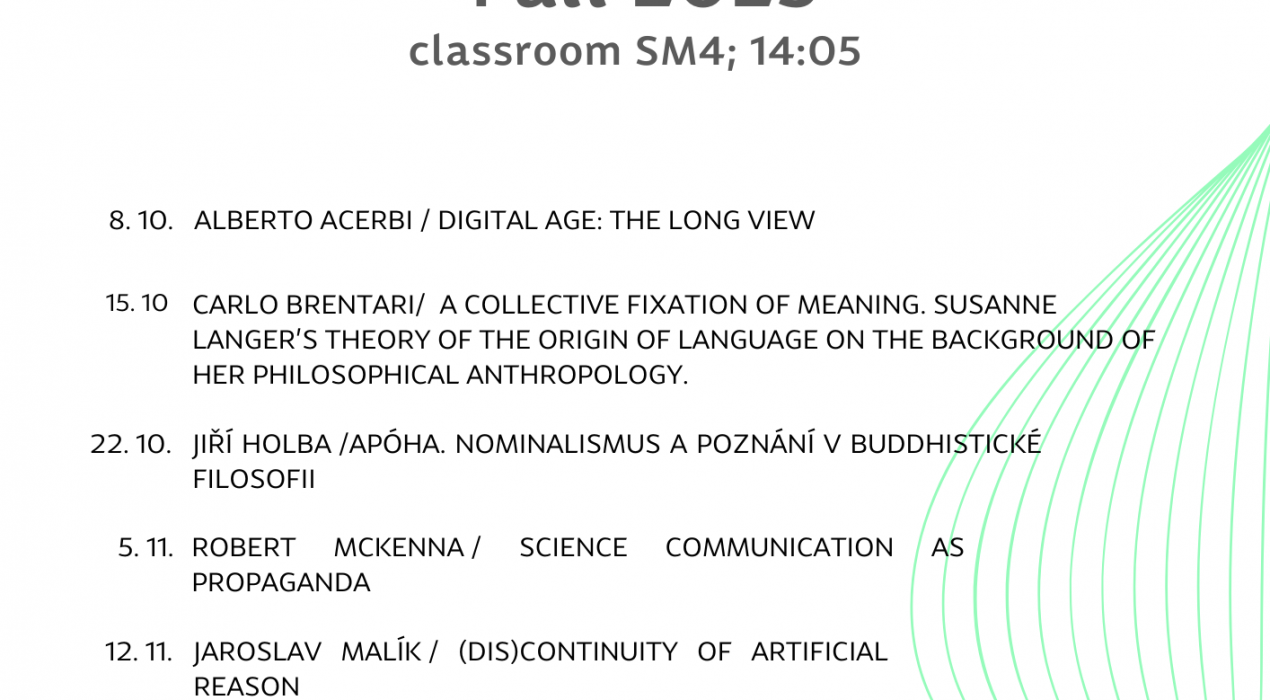
Program LMS Centra: zimní semestr 2025
Zveme všechny zájemce na nový cyklus přednášek LMS Centra pro letní semestr 2024/2025. Semináře pravidelně probíhají v místnosti SM4 od 14:05. Finančně podpořeno z projektu Vědění ve věku nedůvěry, CZ.02.01.01/00/23_025/0008711.
Read More ›
Armin W. Geertz: From mental representations to embodied cognition: The cognitive science of religion past and present
Armin W. Geertz (Aarhus University) From mental representations to embodied cognition: The cognitive science of religion past and present ABSTRAKT: In this lecture, I will provide a brief introduction to the foundational theories and approaches of the cognitive science of religion (CSR) followed by an overview of what has happened since the 1990’s. The CSR has expanded exponentially into a variety of fields and approaches. During the past decade, exciting developments in our understanding of human cognition has led to the rise of embodied approaches under the influence of the so-called 4E movement. This development seems to attract scholars from the humanities, especially historians. Thus, the early skepticism against the CSR seems to be giving way to a more balanced and less confrontational future.
Read More ›

Linda Tvrdíková: Fiction of (Rational) Legislator and Its Intentions?
Linda Tvrdíková (Masarykova univerzita) Fiction of (Rational) Legislator and Its Intentions? ABSTRACT: One of the most important moments when law is linked to reality is its interpretation and application. In the context of authoritative interpretation and application of law, we can find that interpreters often refer to the legislator´s intentions (the so-called subjective teleological method of interpretation, see R. Alexy). In legal scholarship, then, we associate intentionalism with the search for the intentions of the lawmaker and what he actually wanted to communicate through the text of the normative legal act. Proponents of this position argue that what is most important is what the legislator intended to communicate through the text of the normative legal act, what his intentions were. Intentionalists face criticism where the main arguments are that we cannot speak of the legislator as some separately existing entity that might have its own intentions (Dworkin). It is argued that many members of the legislature either do not have an intention that is relevant to the text of the enacting legislation (for example, they vote because someone told them to, or they do not understand what is being voted on at all), or they have different intentions […]
Read More ›