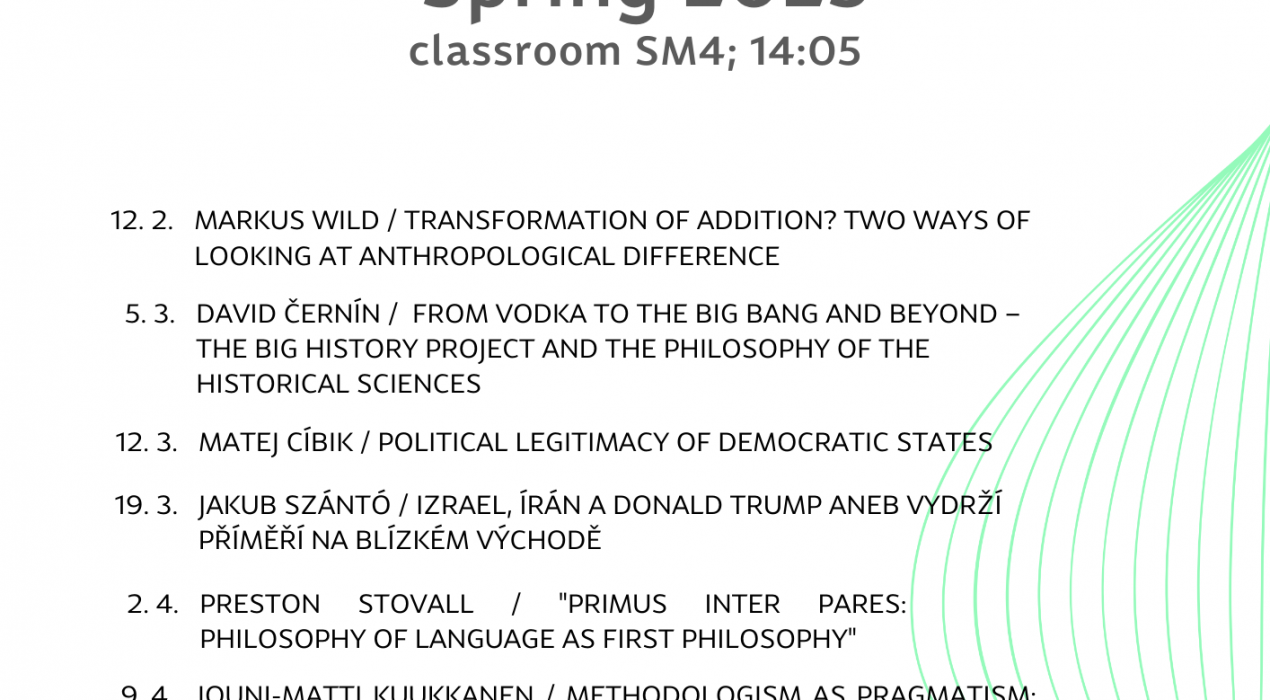
Matej Cíbik: Political Legitimacy of Democratic States
Matej Cíbik (University of Pardubice) Political Legitimacy of Democratic States ABSTRACT: Typically, democratic conceptions of political legitimacy (e. g. Buchanan 2002; Christiano 2004; Estlund 2009) stipulate that a functioning system of free and fair elections is necessary and sufficient for establishing a legitimate government. I disagree: free and fair electoral regime is only the first step toward democratic legitimacy. Equally important is the second step: the acceptance of the given electoral system by the population. My main ambition is to re-interpret the ideal of popular sovereignty as the basis of political legitimacy. I argue that this ideal can never be fully realized solely by organizing elections. A degree of continuous, informal acceptance of the political system (including the acceptance of the specific electoral system chosen by the given country) is also indispensable.
Read More ›

David Černín: From Vodka to the Big Bang and Beyond – the Big History Project and the Philosophy of the Historical Sciences
David Černín (University of Ostrava) From Vodka to the Big Bang and Beyond – the Big History Project and the Philosophy of the Historical Sciences ABSTRACT: Scientists in various fields (from cosmology, geology, and palaeontology to archaeology and historiography) are adept at inferring knowledge of the past and presenting it via distinct theories, models, and narratives. Although “the past” serves as a common denominator of these disciplines, philosophers tend to draw the lines along institutionalised groups, such as natural sciences, social science, and humanities. Consequently, the epistemic status of the past across scientific disciplines ranges from “set-in-stone” realism to nearly fictionised narrative accounts. However, history is not what it used to be, and both practitioners and philosophers are exploring new ways how to engage with the past. On the one hand, we have the Big History project, initiated by David Christian, which influences even school history education and aims to tell a story from the Big Bang to the current era. On the other hand, we have philosophers like Aviezer Tucker, Carol Cleland, Adrian Currie, and Derek Turner, who argue for a broader conception of historical sciences, which includes all disciplines that deal with the past. The talk […]
Read More ›

MARKUS WILD: Transformation of Addition? Two Ways of Looking at Anthropological Difference
Markus Wild (University of Basel) Transformation of Addition? Two Ways of Looking at Anthropological Difference ABSTRACT: Anthropological difference is the fundamental mental difference between humans and animals. A classic example of the anthropological difference is the definition of human beings as rational beings (animal rational). However, there are two different ways of understanding anthropological difference. According to the additive interpretation, the differential trait (e.g. reason) is added to the other cognitive capacities (e.g. perception) and contrive abilities (e.g. desire); according to the transformative interpretation, the differential characteristic changes these capacities and abilities in a profound way. The transformative view is mainly advocated by (broadly speaking) neo-Aristotelian thinkers. In my presentation, I will critically examine the transformative view.
Read More ›

Benjamin Purzycki: Ethnographic Free-Listing: Measuring and Incorporating Culture in the Social Sciences
Benjamin Purzycki (Aarhus University) Ethnographic Free-Listing: Measuring and Incorporating Culture in the Social Sciences ONLINE TALK! Zoom link: https://cesnet.zoom.us/j/96542689460 ABSTRACT: “Culture” has long been considered a major characteristic of and causal factor in human behavior and its variation. Yet, while some of the properties of distinctly human culture are assessed in empirical research projects, these properties are rarely linked to psychological and social contexts in meaningful ways. The free-list task captures important elements of what people know, believe, and what they communicate to each other. It also accounts for the distribution of cultural information and can be useful in assessing how culture affects human decisions and behavior. This talk profiles the method of ethnographic free-listing, highlights its utility across analytical levels including cognition, behavior, communities, and cross-population dynamics, and points to some ideas about future developments in the technique.
Read More ›

Kristine Hill: Sun, Sea, and Cats: Transspecies Ethnography of a Cat Colony on the Costa del Sol
Kristine Hill (University of Hradec Králové) Sun, Sea, and Cats: Transspecies Ethnography of a Cat Colony on the Costa del Sol ABSTRACT: This lecture draws upon my ongoing multispecies ethnographic study of a colony of free-living (unowned) cats (Felis catus) inhabiting a popular vacation destination on the southern coast of Spain. Tourism along the Costa del Sol is built around the classic ‘sun and sea’ style budget holidays, and a large community of British migrants reside seasonally or permanently in the region. Situated at the intersection of tourism, migration, and human-animal studies, my research explores the relationships and cultural interactions between local street cats and human residents and tourists. I build upon the concepts of transnational community-building, residential tourism, and more-than-human cultural co-creation by focusing on how British expatriates, tourism-based business owners, and visitors engage with and relate to local cats. By recognizing cats as sentient beings with subjective minds, my project seeks insight into the feline perspective and an understanding of how they assert agency and influence human attitudes and behaviors. Adopting the concept of humano-cat cultures, which recognizes how different groups of cats develop distinct cultures and unique relationships with different human groups (colony caretakers, residents, […]
Read More ›

Cancelled: Martin Kusch: Objectivity: Hegelian Lineages
Martin Kusch (University of Vienna) Objectivity: Hegelian Lineages ABSTRACT: My paper is a footnote to Lorraine Daston’s and Peter Galison’s influential book Objectivity. Daston and Galison show that our understanding of “objectivity” is a mixed bag of residues of very different epistemic fears and virtues since the 18th century. I want to highlight a dimension of objectivity missing from Daston’s and Galison’s book. I call it the “Geist-conception of objectivity” (GCO). GCO can also best be approached as an attempted solution for period- and place-specific fears directed at the epistemic subject. The place is the German-speaking lands; the period is 1820 to 1980; and the intellectual fears concern: an epistemic subject that high-handedly ignores, or is unable to grasp, its history, traditions, and epistemic communities; an epistemic subject (“historical consciousness”) unable to defend the importance of the Geisteswissenschaften; an epistemic subject incapable of overcoming psychologism, or of grasping invariant, ideal truths; an epistemic subject (“class consciousness”) unable to grasp social-political-economic realities; an epistemic subject naïvely ignoring deep cultural and national differences; or an epistemic subject falling naïvely into cultural relativism. I shall follow the development of GCO from Hegel via Lazarus, Steinthal, Simmel, Dilthey, Freyer and Hartmann to […]
Read More ›

Sybren Heyndels: Modality and Normativity
Sybren Heyndels (Charles University) Modality and Normativity ABSTRACT: Modal normativism is the philosophical position that the central function of modal vocabulary is to convey norms of reasoning. This view is significant in at least two ways. First, it supports a broadly pragmatist, anti-metaphysical approach that aims to demystify philosophical discussions surrounding the metaphysics of modality and the status of heavyweight metaphysics more generally. Secondly, it examines the intricate relationship between alethic modal and deontic normative vocabularies to shed light on the concept of intentionality, the hallmark of human consciousness. In this talk, I will (1) explore the history of modal normativism, (2) criticize aspects of contemporary modal normativism, and (3) propose some ways to address these issues. The first part of the talk will provide an overview of the development from Carnap’s syntactical account of modality to Sellars’ analysis, leading to the contemporary theories of Robert Brandom and Amie Thomasson. In the second part of the talk, I will raise several challenges for Thomasson’s modal normativism. Specifically, I will argue that Thomasson’s theory does not sufficiently clarify (1) the precise sense in which modal statements are said to ‘convey’ normative propositions, (2) what types of normative propositions are […]
Read More ›

Anna Michalík Kvíčalová: Uncertain Sounds: Audio forensics and science in the courtroom in Cold-War Czechoslovakia
Anna Michalík Kvíčalová (Charles University) Uncertain Sounds: Audio forensics and science in the courtroom in Cold-War Czechoslovakia ABSTRACT: Wiretapping telephone lines, bugging hotel rooms, and eavesdropping on private conversations, were all part and parcel of the Cold War surveillance practices. However, to find out whose voices they were monitoring, to identify anonymous speakers in distorted recordings, and provide insights about the surroundings where a phone call took place, a different kind of sound analysis required. The talk will introduce a specialized audio forensic department established at the Prague Institute of Criminalistics in 1975 to examine the spectrographic, linguistic, and auditory means of sound analysis for forensic purposes. What must be done with sonic traces to translate them into different kinds of legal and criminalistic evidence, and how listening becomes a tool of objective knowledge in the sciences? I will show that the contested nature of sound-based objectivity, pertaining to the inconclusiveness of the spectrographic images of the voice and a continuous reliance on professional audition in sound analysis, directly contributed to the rise of probabilistic claims in forensic science, both in the Eastern Bloc countries and in the West. I will argue that the probability scale introduced elements […]
Read More ›

Ladislav Koreň: Transformative Theory of Rationality: A Critique
Ladislav Koreň (University of Hradec Králové) Transformative Theory of Rationality: A Critique ABSTRACT: In my talk I will focus on a recent elaboration of the venerable view of humans as rational animals. On that elaboration, called Transformative Theory of Rationality (TT), basic animal powers for perception, desire, belief or volition can be realized in a rational or non-rational manner (McDowell, 1994, Boyle 2016, Marcus 2022). In rational animals, such powers are informed by rationality, properly understood. So, we can say that rationality transforms them. In non-rational animals, such powers are not informed by rationality. Put differently: there are two kinds of minds: rational and non-rational. Mathew Boyle (2016), following John McDowell (1994), proposes that, properly developed, TT is an attractive account of human rationality. He proceeds via a critique of so-called Additive Theories of Rationality (AT). According to them, we are rational because we possess special rational powers in addition to non-rational mental powers that we share, in basically the same form, with other animals. Boyle argues that AT faces serious problems, whereas TT does not. This demonstrates the promise of TT. Having introduced the debate and Boyle‘s critique of AT – focusing on so-called problems of Interaction […]
Read More ›