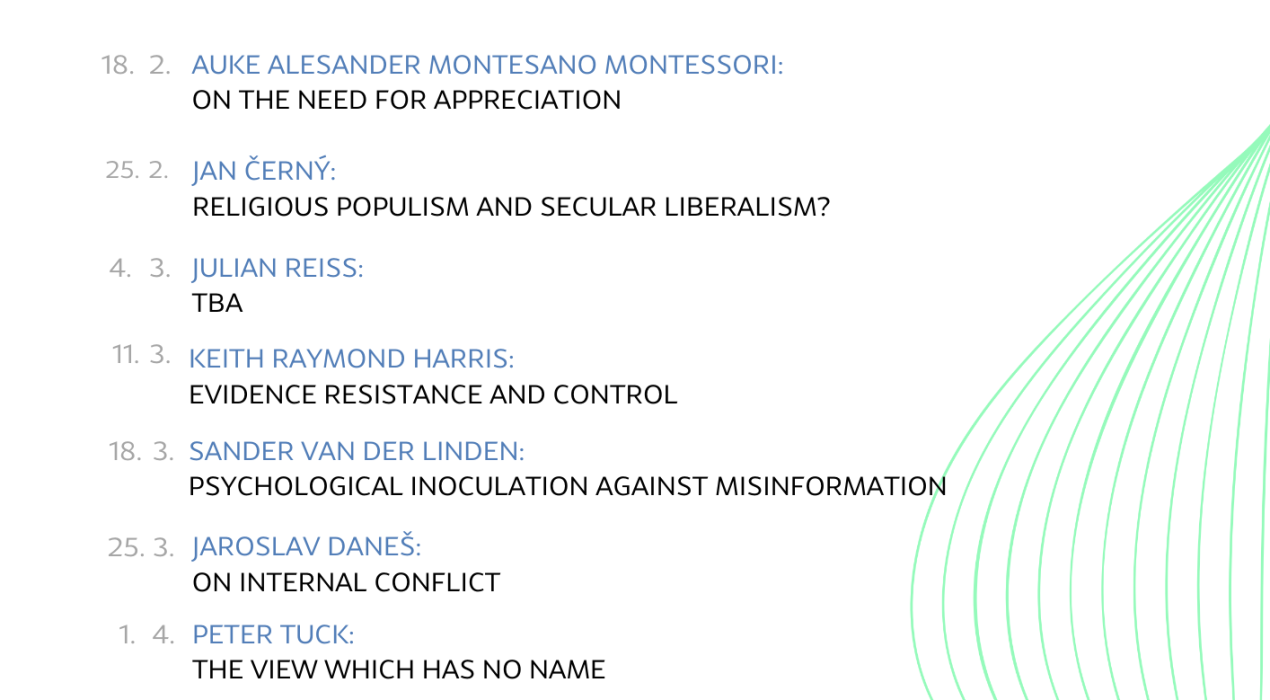
LMS Centre Program: Spring 2026
LMS Centre invites everyone to internal seminars and invited talks in the Spring semester 2026. The seminars are regularly held in the room SM4 and start at 14:05. The activity of LMS Centre is financially supported by the project OP JAK: Knowledge in the Age of Distrust, CZ.02.01.01/00/23_025/0008711.
Read More ›

Robert McKenna: Science Communication as Propaganda
Robert McKenna (University of Liverpool) Science Communication as Propaganda You can also follow us on: https://cesnet.zoom.us/j/91813080382 ABSTRACT: There is a tension at the heart of science communication. On the one hand, its advocates often say that it simply aims to inform the public about relevant advances in science, along with providing them with scientific information that is relevant to their lives and choices (getting vaccinated, buying an electric vehicle, etc.). On the other hand, some public science communication seems more geared towards persuading the public of things (the need to get vaccinated or to buy an electric vehicle) than simply informing them. Moreover, science communication also occurs in the context of public policy making, where the role of the science communicator is not simply to inform policy makers of relevant scientific knowledge but to offer guidance and recommendations. Science communication is therefore intertwined with the technocratic structure of many modern societies. In this talk I suggest that viewing certain forms of science communication as a distinctive kind of propaganda is a helpful way of understanding the tension at the heart of science communication. One reason why it is helpful is it provides a plausible explanation of the […]
Read More ›

Carlo Brentari: A collective fixation of meaning. Susanne Langer’s theory of the origin of language on the background of her philosophical anthropology
Carlo Brentari (University of Trento) A collective fixation of meaning. Susanne Langer’s theory of the origin of language on the background of her philosophical anthropology ABSTRACT: My talk for the LMS Centre will focus on the philosophical-anthropological theory of the origin of language developed by the American philosopher Susanne K. Langer (1895-1985). Langer traces human language – and, in particular, its denotative and communicative functions – back to the expressive vocal utterances of the primates from which humanity has derived. In her inquiry, Langer refers to the work of the language psychologist J. Donovan, who outlines a possible scenario of the birth of language out from pre-linguistic utterances: the spontaneous gatherings that hominids would have dedicated to emotionally relevant events and objects (the death of a conspecific, a killed predator or enemy). Besides being convincing in itself, Langer’s reflection on the origin of language allows us to highlight a question of particular importance in anthropology: how should evolutionism be rethought so that it can account for the emergence of biological phenomena which, like language, were probably not particularly advantageous at their first appearence?
Read More ›

Alberto Acerbi: Digital Age: The Long View
Alberto Acerbi (University of Trento) Digital Age: The Long View ONLINE TALK! Zoom link: https://cesnet.zoom.us/j/91813080382 ABSTRACT: In my talk, I will discuss how cultural evolution – an umbrella term for evolutionary and cognitive approaches to human culture – can provide a useful framework for understanding how information is produced, transmitted, and selected in contemporary online digital media. A key implication of this perspective is that it suggests, contrary to common concerns, that we are generally wary learners who are not easily influenced. The (limited) spread of online misinformation can be understood in this perspective by focusing on the idea that some cultural traits can be successful because their content taps into general cognitive biases. More generally, given that only a small fraction of online content is misinformation, and, despite the abundance of accurate information, people are often overskeptical or uninterested, I will argue that research should focus more on the spread of reliable news. I will present recent work showing that, like misinformation, factual news exploits evolved cognitive biases, with negative, group-oriented, and dominance-oriented contents consistently predicting engagement. This LMS Centre talk is financially supported by the project OP JAK: Knowledge in the Age of Distrust, […]
Read More ›
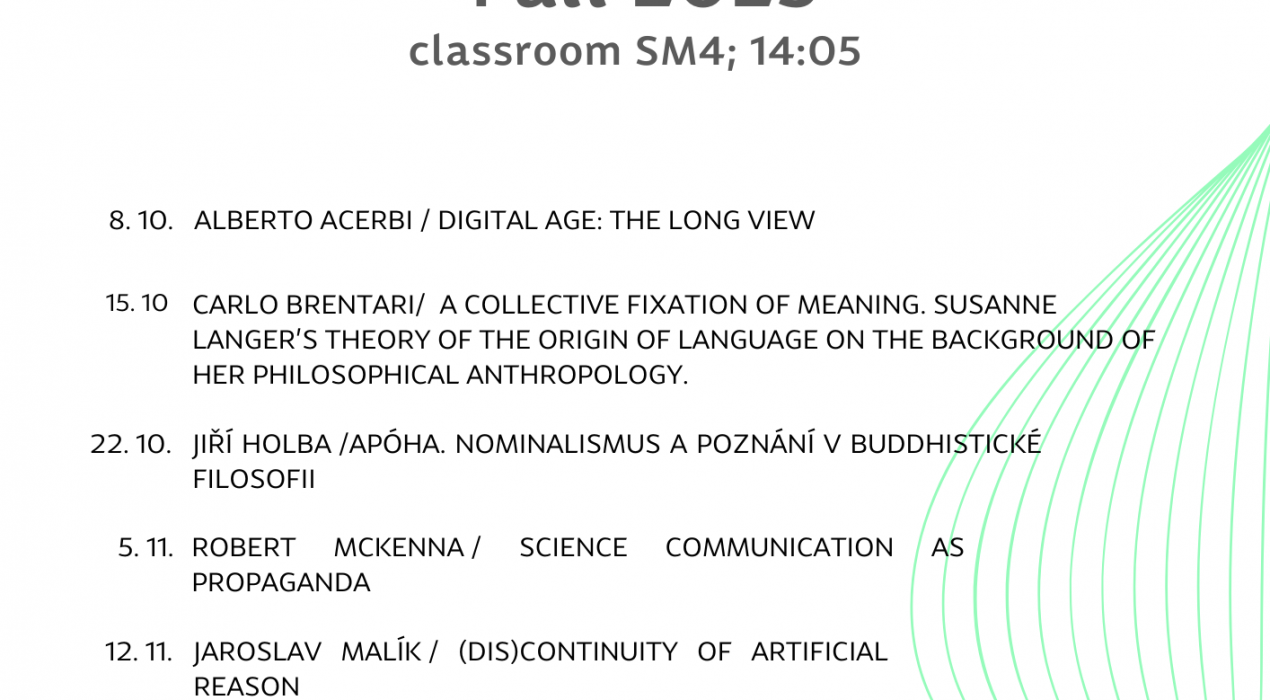
LMS Centre Program: Fall 2025
LMS Centre invites everyone to internal seminars and invited talks in the Spring semester 2024/2025. The seminars are regularly held in the room SM4 and start at 14:05. The activity of LMS Centre is financially supported by the project OP JAK: Knowledge in the Age of Distrust, CZ.02.01.01/00/23_025/0008711.
Read More ›
Armin W. Geertz: From mental representations to embodied cognition: The cognitive science of religion past and present
Armin W. Geertz (Aarhus University) From mental representations to embodied cognition: The cognitive science of religion past and present ABSTRACT: In this lecture, I will provide a brief introduction to the foundational theories and approaches of the cognitive science of religion (CSR) followed by an overview of what has happened since the 1990’s. The CSR has expanded exponentially into a variety of fields and approaches. During the past decade, exciting developments in our understanding of human cognition has led to the rise of embodied approaches under the influence of the so-called 4E movement. This development seems to attract scholars from the humanities, especially historians. Thus, the early skepticism against the CSR seems to be giving way to a more balanced and less confrontational future.
Read More ›

Linda Tvrdíková: Fiction of (Rational) Legislator and Its Intentions?
Linda Tvrdíková (Masaryk University) Fiction of (Rational) Legislator and Its Intentions? ABSTRACT: One of the most important moments when law is linked to reality is its interpretation and application. In the context of authoritative interpretation and application of law, we can find that interpreters often refer to the legislator´s intentions (the so-called subjective teleological method of interpretation, see R. Alexy). In legal scholarship, then, we associate intentionalism with the search for the intentions of the lawmaker and what he actually wanted to communicate through the text of the normative legal act. Proponents of this position argue that what is most important is what the legislator intended to communicate through the text of the normative legal act, what his intentions were. Intentionalists face criticism where the main arguments are that we cannot speak of the legislator as some separately existing entity that might have its own intentions (Dworkin). It is argued that many members of the legislature either do not have an intention that is relevant to the text of the enacting legislation (for example, they vote because someone told them to, or they do not understand what is being voted on at all), or they have different intentions […]
Read More ›

Anežka Kuzmičová: Why children undervalue their informational reading and why it matters
Anežka Kuzmičová (Charles University) Why children undervalue their informational reading and why it matters ABSTRACT: Most of the text we encounter in everyday life is nonfiction rather than fiction. Yet while fiction reading is widely researched and promoted for its whole-person benefits, informational reading continues to be understood as utilitarian and devoid of affect. To address this imbalance, my research team and I have conducted a holistic child-centred interview study (N = 20, ages 9-11) inviting children’s own reflection on nonfiction-related experience. Children first reflected on their real-world interests and on the various activities through which they nurture them. Then the interviews zoomed in on reading and nonfiction text design. In the children’s reflections, we found a strong pattern of undervaluing or not noticing one’s informational reading, due to two sets of constraints: (a) conceptual constraints, i.e., discursive biases about reading, and (b) phenomenal constraints, i.e., inherent characteristics that may indeed make informational reading inherently less amenable to reflection than fiction reading. I will detail these constraints and discuss their ramifications for education more generally.
Read More ›

Jouni-Matti Kuukkanen: Methodologism as Pragmatism: What Getting it Right Means?
Jouni-Matti Kuukkanen (University of Oulu) Methodologism as Pragmatism: What Getting it Right Means? ABSTRACT: In my forthcoming book, Doing, Knowing, and Getting it Right: Methodologism as Pragmatism (Cambridge University Press), I call my approach to knowing and meaning ‘methodologism.’ Building on the influential philosophies of Wilfrid Sellars, Robert Brandom, Jaroslav Peregrin, and Huw Price, this book introduces a novel neo-pragmatist philosophy. In this talk, I will explain how my approach differs from these and what methodologism means. Firstly, methodologism is resolutely anti-representationalist in both epistemology and the philosophy of language. A key idea is that knowing can, in general, be defined as a correct way of doing. This view applies to both the sciences and more mundane ways of knowing in our various forms of life. Colloquially speaking, ‘methods’ are correct rule-bound ways of doing things. Another key idea is the classical pragmatist view that our most fundamental aim in epistemological approaches is to settle our beliefs. In the absence of a settlement (or the possibility of achieving a settlement in practice), the secondary aim is to guide our conversational practice. These are two general goals for our ‘methods.’ Further, while the methodologist framework and a path to […]
Read More ›

Preston Stovall: Primus Inter Pares: Philosophy of Language as First Philosophy
Preston Stovall (University of Hradec Králové) Primus Inter Pares: Philosophy of Language as First Philosophy ABSTRACT: It is an open question whether and in what sense non-linguistic animals are capable of cognitive acts that have logical content, and of how explicitly codified deduction systems like those of classical logic might relate to whatever sort of cognition non-human animals are capable of. In this essay, I draw on two-factor approaches to human cognition, as well as a joint model-theoretic and proof-theoretic semantics for natural language, to show that a practical capacity for accepting and rejecting cognitive acts accounts for cognition as having a deductive logical structure but not content. On this basis, I hypothesize that the ability to engage in such self-directed cognitive acts is an evolutionary bridge linking simpler non-human and linguistic human cognition. Relating the proposal to bilateral proof systems, I show that a unilateral account of deductive inference specified in terms of assertion alone, where logical operations are accounted for in terms of content rather than structure, would be more parsimonious in communicating over and propagating the rules of such systems. This provides a plausible explanation for why logical instruction would occur in a unilateral assertion-based rather than a bilateral framework today even […]
Read More ›